



VELUTI CASA (Note: the company name is a pseudonym used to protect client privacy) is a luxury furniture brand originating from Italy. With boutiques in Shanghai, the brand specializes in high-end customized furniture such as sofas, coffee tables, and beds. Its business model heavily relies on front-end design consultations and co-creation with clients, characterized by high average order values (AOV) and long sales decision cycles.

VELUTI CASA needed to track the entire lifecycle of an order from the initial sales quotation to revenue recognition, while simultaneously managing a cross-border supply chain. At the same time, management’s requirements for multi-dimensional managerial accounting far exceeded the standard capabilities of traditional ERP systems. To address these operational pain points, VELUTI CASA implemented the Jeenie Cloud ERP system.
The following sections detail the actual business scenarios and practical implementation of how Jeenie fulfilled VELUTI CASA’s specific management needs.
- Flexible Document Flow in Sales: Supporting Three Business Models to Streamline the Complex Lifecycle of “Make to Order”
In VELUTI CASA’s sales scenarios, daily operations are primarily driven by three core business models:
- Grab & Go: Direct sales of showroom displays or local inventory. Customers take delivery immediately upon payment, featuring a short process and fast document closure.
- Make to Order: The brand’s core and most complex source of revenue. Products are entirely personalized based on customer requirements—combining fabric, color, and dimensions—and are scheduled for production at European factories.
- Clearance: Discounted sales of showroom display samples, where the system must independently track and account for specific sales performance under this model.
Jeenie’s Solution:
We will map out the system operations using the most complex “Make to Order” model as the primary example. Due to frequent changes in materials, colors, and dimensions during high-end furniture customization, it is often impossible to determine the final product SKU code in the early stages. Exhaustively generating SKU codes based on every permutation of product attributes would cause severe master data redundancy in the system. Furthermore, due to strict coding structures, these formal long codes must typically be generated by the overseas headquarters once the final product attributes are confirmed. To resolve this workflow pain point, Jeenie provides a controlled revision solution that perfectly aligns with this business reality:
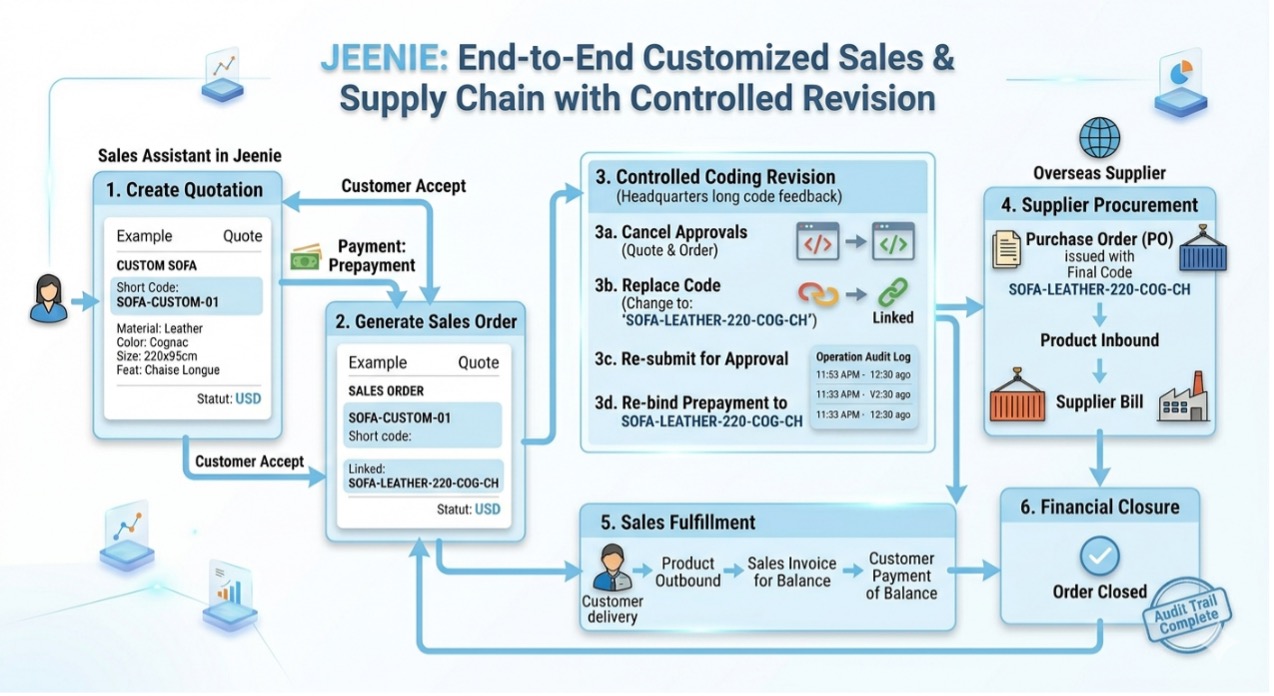
- Flowing from Sales Quotation to Order: Sales assistants in Jeenie initially create a Quotation using temporary “short codes” that represent broad product categories, and describe the specific custom attributes (e.g., a specific sofa model, material, and dimensions) in detail directly within the line items. Once the customer accepts the quotation and makes a prepayment, the system allows the user to directly generate a formal Sales Order based on that quotation, precisely linking the prepayment, sales order, and the historical quotation.
- Controlled Coding Revision: Once the overseas headquarters provides the formal “long code,” Jeenie facilitates a rigorous and controlled document revision process: Cancel Approvals (for Quote & Order) $rightarrow$ Replace Code (change temporary short code to formal long SKU code) $rightarrow$ Re-submit for Approval $rightarrow$ Re-bind Prepayment. This workflow ensures that the prepayment corresponds accurately with the latest formal order line, and every modification is recorded in a detailed audit log for full traceability.
- Supplier Procurement Process: Upon receiving the customer’s prepayment and confirming the final product code, the system drives the creation of a Purchase Order (PO) issued to the overseas supplier. It then seamlessly manages the subsequent back-end supply chain loop: Purchase Order $rightarrow$ Product Inbound $rightarrow$ Supplier Bill.
- Sales Fulfillment and Balance Collection: When the customized product is received in stock and ready for delivery, the system triggers the product outbound process and simultaneously generates a Sales Invoice to collect the remaining balance from the customer, finally completing the financial closing of the entire sales order.
Through this four-step flow—stretching from non-standard quotations and controlled coding revisions to back-end procurement, final shipping, and balance collection—Jeenie satisfies the flexibility required by front-end sales while ensuring the rigor of back-end supply chain and financial reconciliation.
- Code-Free Custom Fields: Facilitating Additional Attributes and Multi-Dimensional Accounting
VELUTI CASA’s management looks at performance through multi-dimensional and flexible perspectives. They need to enforce strict validity periods on each quotation to ensure precise follow-ups on potential leads. Concurrently, the finance team and executive management require granular accounting capabilities, such as “analyzing revenue and costs by business type” and “analyzing profitability by cost center.”
Jeenie’s Solution:
Jeenie innovatively introduced the “Additional Attributes” feature. This function allows users to independently extend personalized data fields on both the headers and line items of master data and business documents (such as sales quotations and sales orders). Crucially, these additional attributes possess end-to-end “business-finance integrated” routing capabilities: data is automatically carried over from master data to business documents, automatically extends to journal entries when a transaction occurs, and flows directly into financial and management reports. Through this continuous data pipeline, enterprises can efficiently capture personalized business data across multiple operational facets, achieving deep, fine-grained accounting and multi-dimensional reporting analysis.
The specific configurations and application scenarios for VELUTI CASA are detailed below:
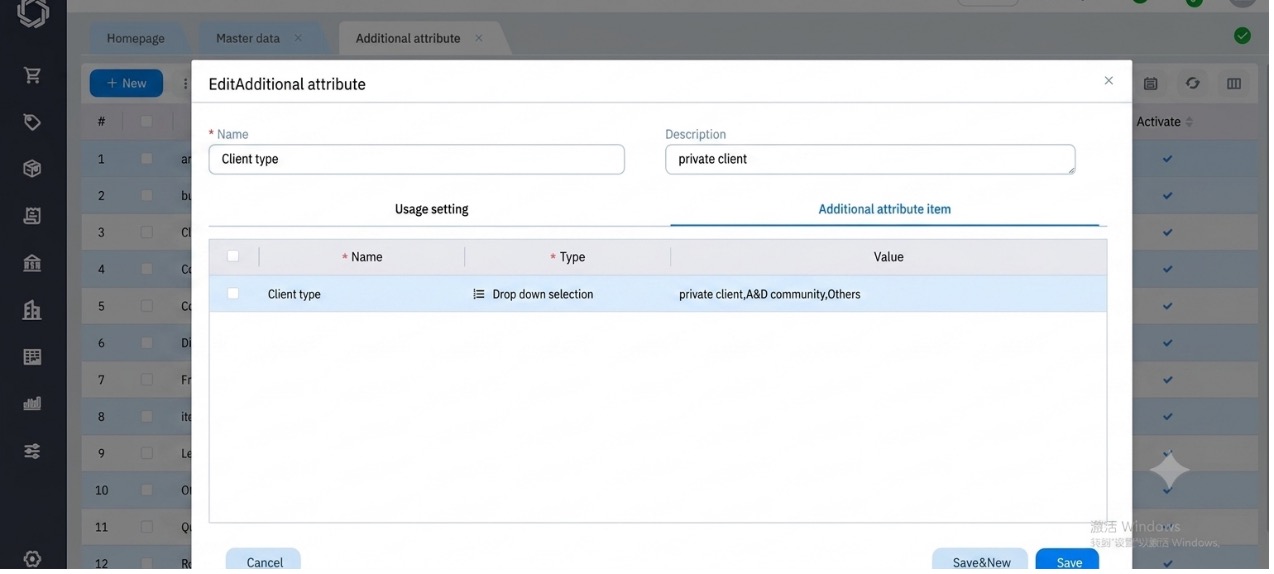
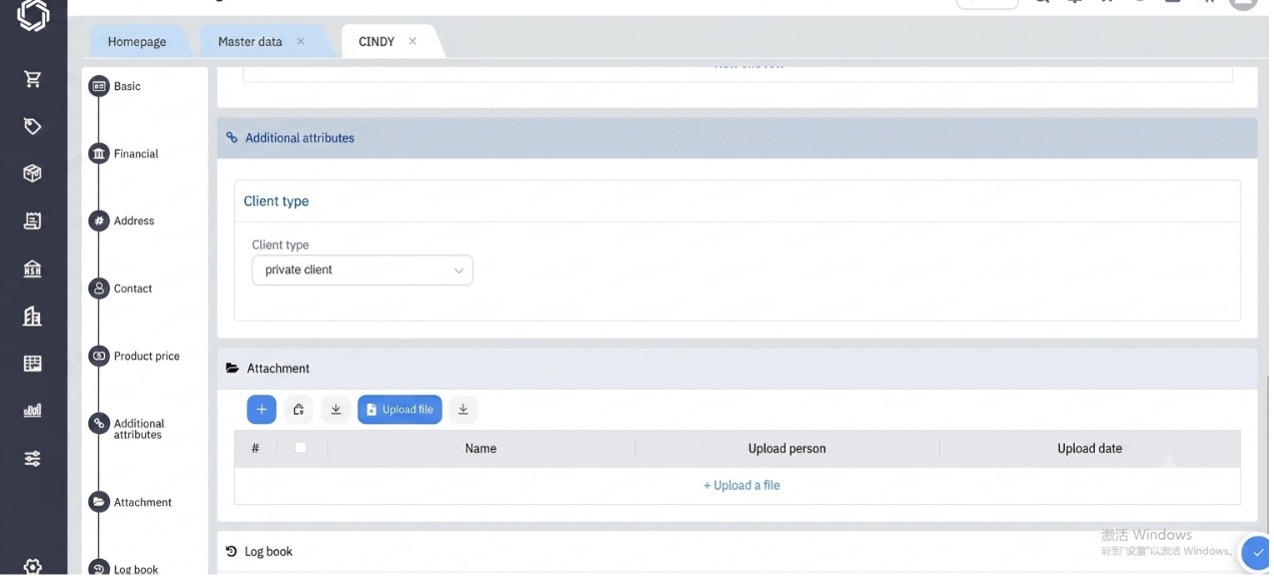
- Client Type Classification: The enterprise independently added a “Client Type” field via Additional Attributes, configuring a drop-down menu with three options: “Private Client,” “A&D Community (Architects & Designers channel),” and “Other.” By configuring the client type within the customer master data and adding “Client Type” as an accounting dimension to financial accounts, management can instantly retrieve sales data across different client segments without tedious manual aggregation.
The step-by-step application of this additional attribute is illustrated below:
- Step 1: Add a new additional attribute named “Client type”, set the input type to “Drop down selection”, and add the values: “private client”, “A&D community”, and “Others”.
- Step 2: Add “Client type” as an additional attribute within the customer master data and define the specific type for the customer.
- Step 3: Add “Client type” as an accounting dimension to the primary operating revenue account.
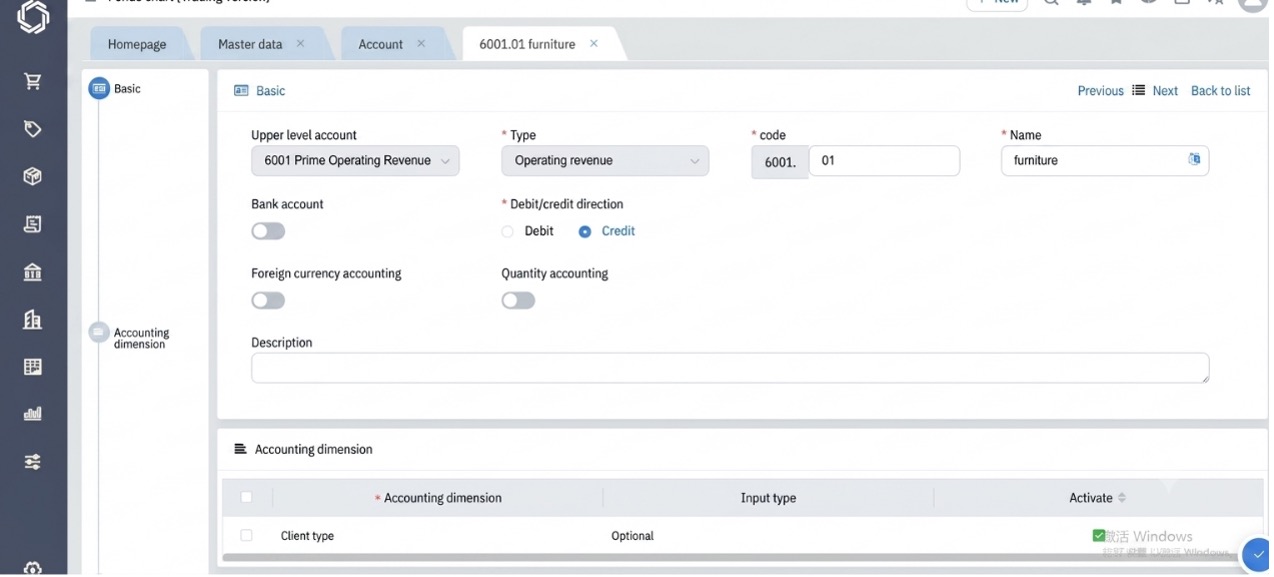
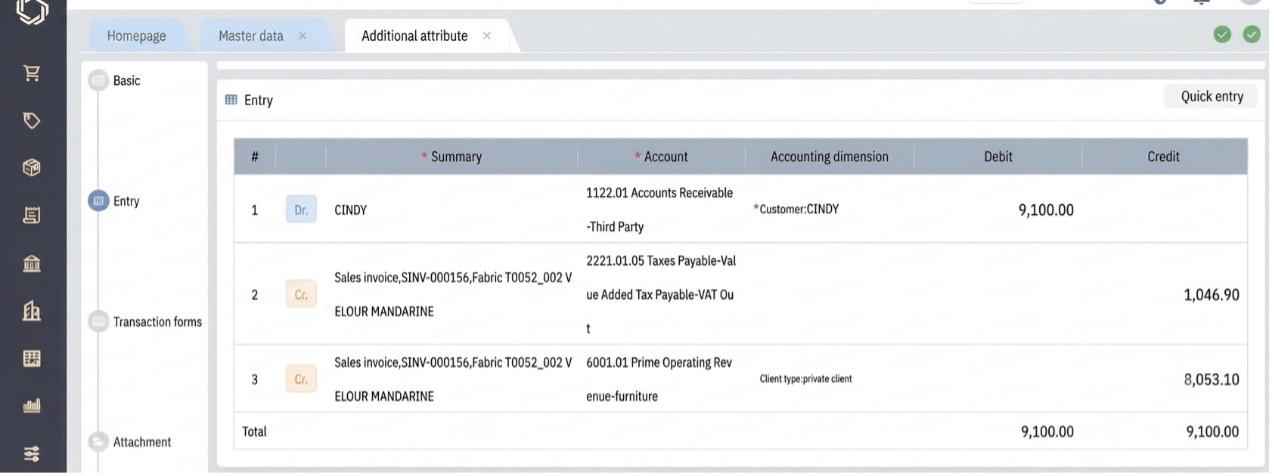
- Step 4: When an revenue journal entry is generated via a Sales Invoice, the revenue account automatically inherits the client type as an accounting dimension.
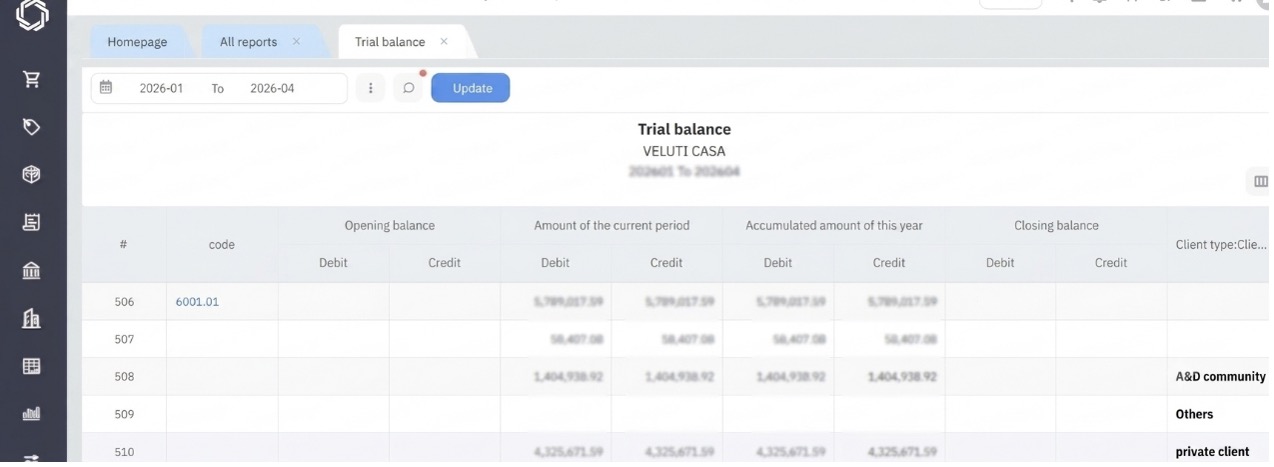
- Step 5: The Trial Balance report can now display financial data categorized by different client types.
- End-to-End Flow for “Business Type” Accounting: The system configured a “Business Type” additional attribute, with drop-down options including “Grab & Go,” “Make to Order,” and “Clearance.”
- Line Item Application: This attribute was applied directly to the line items of sales quotations, sales orders, inventory outbound deliveries, and sales invoices.
- Direct Link to Accounting Dimensions: Finance set the “Business Type” attribute as a required accounting dimension on accounts like “Revenue” and “Cost of Goods Sold.” When sales personnel input documents on the front end and generate business transactions, the business type from the line items automatically carries over to the corresponding ledger accounts. This business-finance integration mechanism enables the financial system to automatically generate granular profit and loss statements broken down by business type.
- “Cost Center” Additional Attribute: The enterprise configured cost center attributes for dimensions such as “Shanghai Boutique” and “Back Office.” VELUTI CASA’s finance team can accurately allocate daily personnel expenses, administrative overhead, and various operating costs to specific cost centers, effortlessly upgrading their financial management to a sophisticated “Profit Center” accounting model.
- Excel Reporting Tool: Customized Management Dashboards Free from Fixed Report Limitations
Although Jeenie comes pre-built with an array of standard operational reports that comprehensively cover the vast majority of day-to-day data tracking needs, VELUTI CASA frequently required specific report formats and unique analytical angles for its management team.
Jeenie’s Solution:
To eliminate the tedious monthly routine where the finance team had to export raw data from the system and manually perform VLOOKUPs in Excel to compile reports, Jeenie provided an Excel Reporting Tool. This tool seamlessly links complex business data with deep financial accounts. Users can pull real-time system data with a single click directly within the familiar Excel interface. Leveraging Excel’s powerful formulas and charting capabilities, it delivers operational efficiencies that traditional ERP systems cannot match.
VELUTI CASA utilized this tool to build three completely proprietary, customized management reports:
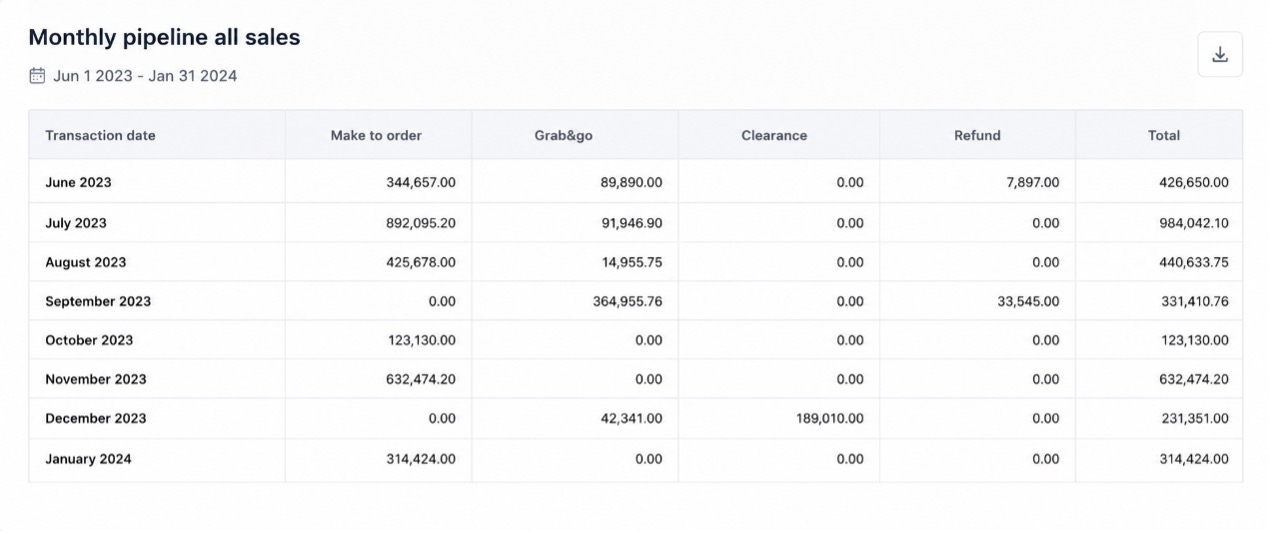
- Report 1—Monthly Sales Report: This report is designed to cross-analyze revenue across different months and business types. Utilizing Jeenie’s Excel Reporting Tool, the report automatically extracts the “Business Type” additional attribute from system documents, helping management precisely evaluate two core areas : monitoring the overarching revenue structure to see monthly sales trends for stock, custom, and clearance items to optimize procurement and promotional strategies; and conducting multi-dimensional analyses of refund data to uncover root causes in products and services, thereby driving quality improvements.
- Report 2—Quotation Analysis Report: This report analyzes all quotations sent to customers. It tracks how many quotes were accepted, rejected, expired, or are still being followed up, and provides a cross-period comparison of the total value of accepted quotes over multiple months. This allows management to clearly evaluate overall market demand and sales performance across different periods.
- Report 3—Sales Assistant Performance Report: This report focuses on the monthly sales performance of individual sales representatives, tracking both total contract signatures and actual collection progress. The report helps management optimize operations across two main dimensions : calculating performance bonuses accurately by linking incentives to actual cash inflows (deposits/balances), thereby avoiding the financial risk of overpaying commissions based purely on written book value; and building employee profiles to clearly visualize who excels at closing long-cycle custom orders versus who excels at liquidating inventory through showroom clearance sales, providing core data support for adjusting tiered commissions and optimizing team conversion rates.
Reports built via the Excel Reporting Tool only need to be designed and tested once; thereafter, they can be reused month after month. VELUTI CASA’s finance team no longer needs to spend the first three days of every month manually reconciling data and adding classification tags. Instead, they simply open the pre-built template and click “Refresh.” Within minutes, they obtain management reports already sorted by customer segment, product line, cost center, and business type.
Conclusion
The case of VELUTI CASA demonstrates that when faced with highly complex, industry-specific operational needs, Jeenie provides a highly flexible software environment that natively aligns with customized business logic. It successfully cracks the management challenges inherent in non-standard trade and high-end retail, helping enterprises transform complex offline workflows into standardized, high-efficiency digital processes, ultimately achieving deep operational synergy and fine-grained management.